
Smart Farm → Smart Factory → Smart Supply Chain → Global Market

Build a Climate-Resilient Food System

From Smart Farm to Smart Factory to Global Market

Connect agriculture, food manufacturing, environmental compliance, traceability, climate intelligence and export readiness in one integrated platform.

84 / 100
Food System Resilience
94%
Compliance current
79%
Export readiness
24,180 t
CO₂e prevented
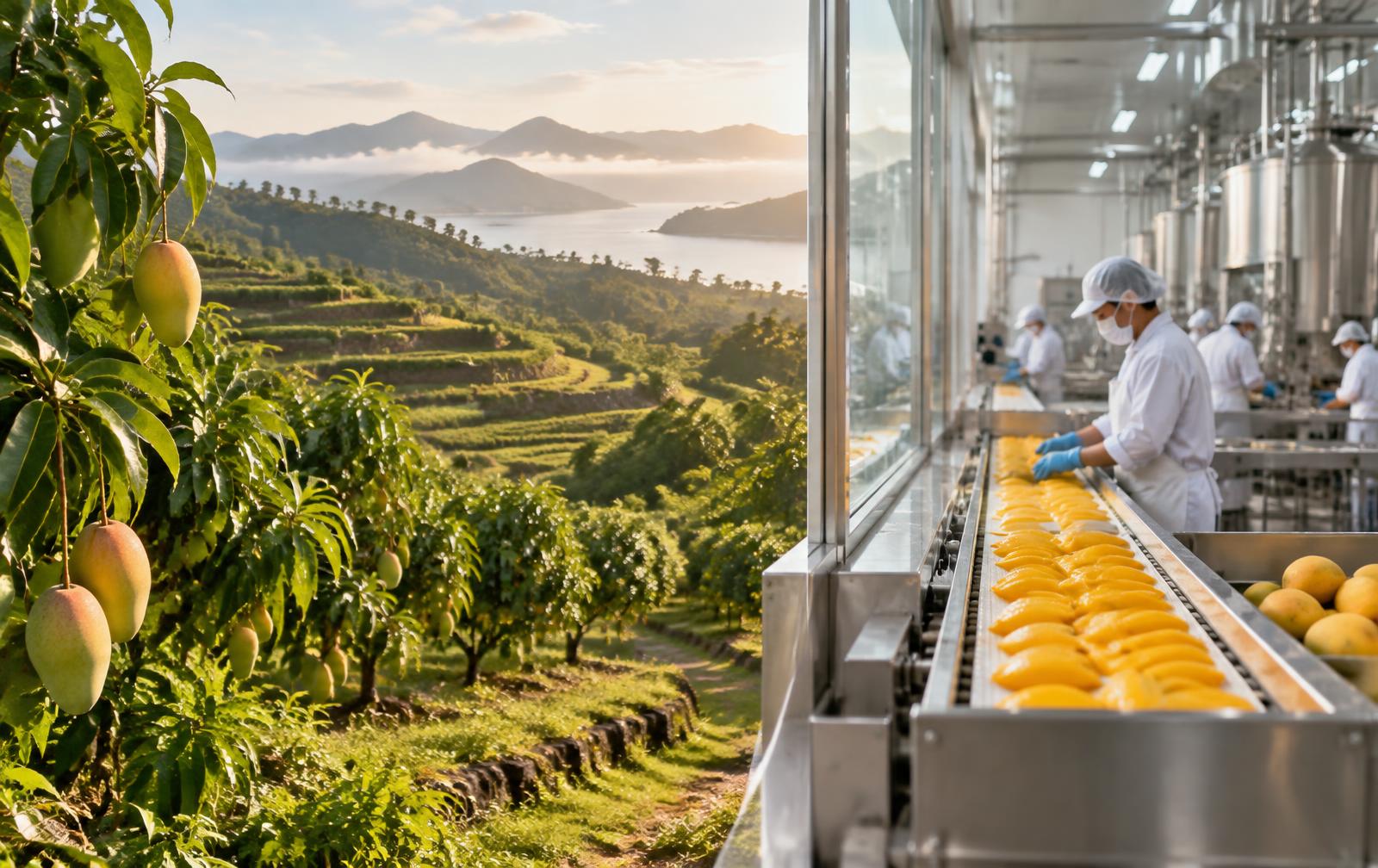
Philippine mango orchard at sunrise beside a bright food processing line

The problem

Production, processing, compliance and export readiness sit in separate systems

Farmers plant without reliable market or climate information. Factories cannot see raw-material supply or environmental performance in real time. Exporters are asked for evidence that nobody has assembled yet. The result is spoilage, downtime, compliance exposure and lost value.

The opportunity

The Philippines can create far more value from what it already grows

Connecting agricultural production with advanced food processing turns surplus harvest into higher-value products, and turns environmental data into export credibility. The farm is the first factory of the food economy.

The ecosystem, end to end

Every important event generates structured data: what happened, where, when, who was responsible, what was measured, whether it was compliant.

  1. 01Smart Farm
  2. 02Climate-Resilient Production
  3. 03Smart Factory
  4. 04Digital Traceability
  5. 05Export Readiness
  6. 06Climate Impact

One digital infrastructure, six layers

Module 1

Smart Agriculture

Market intelligence, farm records, crop planning and yield forecasting, so production follows demand instead of guesswork.

Module 2

Climate-Resilient Production

A resilience score across drought, flood, heat, typhoon, pest, water and infrastructure exposure, with risk, impact and action on every alert.

Module 3

Smart Food Factory

Production, yield, downtime, energy, water, waste, wastewater and cold chain in one operating view.

Module 4

Digital Traceability & Compliance

Farm to supplier to batch to processing to logistics to export, with permits and monitoring records tracked and reminded.

Module 5

Export Readiness

A continuous readiness score per product and market, with the missing documents named before a buyer asks.

Module 6

Climate & Environmental Impact

Carbon, energy, water, waste and food loss avoided, rolled into ECEP — Envi-Comm Carbon Emissions Prevented.

AI + Data + IoT + Experts

Intelligence that helps experts see risk earlier

The Envi-Comm Climate Copilot reads farm, factory, compliance and supply data and answers as Finding → Evidence → Risk → Recommendation → Recommended Action. It supports environmental, engineering, agricultural, food-safety and regulatory professionals. It does not replace them.

AI intelligence layer
Operational and climate data
IoT and sensor readings
Accredited professionals

Sample Copilot answer

Finding

Water intensity at the Davao line is 4.8 L/kg against a 3.6 L/kg target — the largest single resource loss this quarter.

Evidence

Facility #07 intake meter DEV-077 at 38.2 m³/h; reuse loop covering only 22% of process demand.

Risk

Higher wastewater volume against permit limits, plus avoidable cost during the dry season.

Recommendation

Extend the reuse loop to the crate wash and re-sequence clean-in-place cycles.

Recommended Action

Sustainability Manager to scope the reuse extension within 14 days.

From compliance to climate impact

Compliance work becomes measurable operational and climate outcomes

Monitoring, permits, corrective actions and operational control prevent emissions that would otherwise happen. The platform measures that prevention as ECEP — Envi-Comm Carbon Emissions Prevented. ECEP describes prevention, avoidance and reduction. It is not carbon credits and not carbon sequestration.

Evolving from consultant + spreadsheet + PDF to data + intelligence + expert + action.

When you log in, the platform answers

  1. 01How resilient is my operation?
  2. 02What risks require my attention?
  3. 03Where am I losing money or resources?
  4. 04Am I compliant and export-ready?
  5. 05What action should I take next?

Trusted globally

Grown Responsibly in the Philippines.
Processed Efficiently in the Philippines.
Verified Digitally in the Philippines.
Trusted Globally.

Build the Future of Philippine Food Manufacturing

Start in the command center: resilience, risk, resource losses, compliance and export readiness in a single view, with the Climate Copilot alongside.